Posts

Showing posts from 2009
🌿 Share this page

Archiving the intangible systems of African food.
African food are a system of knowledge

Africa told through food, memory, and time.

Documentation: Red Palm Oil (Elaeis guineensis) & Nigerian Groundnut Stew | African Foodways Heritage Archive

Documentation: Red Palm Oil (Elaeis guineensis) & Nigerian Groundnut Stew – Anatomy of a Culinary and Commodity Dichotomy

Archive Entry: African Foodways Heritage Archive
Primary Subject: Red Palm Oil (Elaeis guineensis)
Dish Documentation: Nigerian Groundnut (Peanut) Stew with Chicken
Core Analysis: Cultural Staple vs. Global Commodity
Culinary Region: Nigeria, West Africa (Hausa, Igbo, Yoruba contexts)
Key Context: Most populous African nation; epicenter of palm oil's origin and complex modern legacy
Originally Documented: May 2009 | AFHA Compiled: January 2026

The Central Dichotomy: Red palm oil exists in two parallel realities. In one, it is tochovita—the "red oil" that forms the flavorful, vitamin-rich base of countless West African stews, a cultural keystone with deep historical roots. In the other, it is "Palm Oil"—an anonymous, highly processed commodity embedded in global snacks and biofuels, synonymous with tropical deforestation and land conflict. This entry documents both realities, using Nigerian Groundnut Stew as a lens to explore the tension between an ingredient's immutable cultural meaning and its mutable economic fate.
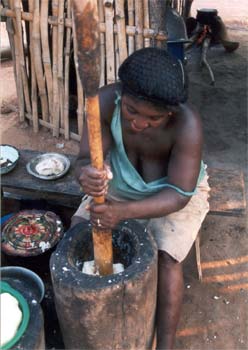
A person using a large pestle to pound fufu in a mortar
Figure 1. Preparing fufu, the quintessential starchy accompaniment to West African stews. This labor-intensive process of pounding boiled cassava or plantains creates a smooth dough designed to scoop and absorb rich, oily sauces like Groundnut Stew, completing the culinary structure.

Duality Analysis: The Two Lives of Elaeis guineensis

Reality 1: Cultural & Culinary Keystone (The "Tochovita")

  • Origin: Native to West and Southwest Africa; domesticated millennia ago.
  • Traditional Processing: Small-scale, manual extraction yielding unrefined, red oil rich in beta-carotene (pro-vitamin A) and tocotrienols (Vitamin E).
  • Culinary Role: Flavor base (earthy, nutty), colorant (vibrant red-orange), and nutrient-dense fat. Essential in soups, stews, and fried dishes.
  • Cultural Significance: Used in rituals, ceremonies, and traditional medicine. A symbol of vitality, wealth, and celebration.
  • Nutritional Profile: The world's richest source of beta-carotene (pro-vitamin A) and tocotrienols (Vitamin E), crucial for combating deficiency. Its fat profile is roughly 50% saturated (predominantly palmitic acid), 40% monounsaturated, and 10% polyunsaturated. Dietary Context Note: In traditional West African diets, where it is consumed as part of diverse, vegetable-rich meals, it contributes significant antioxidants without the isolated health risks associated with high consumption of separated fats in ultra-processed contexts.

Reality 2: Global Industrial Commodity (The "Palm Oil")

  • Modern Production: Large-scale monoculture plantations, primarily in Indonesia and Malaysia (following colonial transplantation from Africa).
  • Industrial Processing: Refined, Bleached, and Deodorized (RBD) to create a neutral, stable, colorless fat for processed foods and cosmetics.
  • Global Role: The world's most produced vegetable oil. Ubiquitous in packaged snacks, margarine, soaps, and biofuels.
  • Controversies: Primary driver of deforestation and biodiversity loss in Southeast Asia. Associated with land grabs, labor abuses, and significant GHG emissions.
  • Nutritional Alteration: RBD processing strips most phytonutrients (carotenoids, vitamin E), leaving mainly the fat structure.

The Nigerian Context: Producer & Consumer Nexus

  • Historical Position: World's largest producer until the mid-20th century; origin of the global commodity.
  • Current Status (2023-2024): A net importer, spending ~$600 million annually on mostly refined palm oil. Domestic production (~1.4M MT) fails to meet demand, with smallholders still producing traditional red oil for local cuisine.
  • Projection (2025-2026): Domestic production is estimated to rise slightly (~1.5M MT), but the reliance on cheaper, refined imports persists, highlighting a deep structural gap in the local oil processing industry.
  • Ethnic Integration: A unifying ingredient across the Hausa (North), Igbo (East), and Yoruba (West) culinary traditions, albeit with regional variations.

Culinary Case Study: Nigerian Groundnut Stew with Palm Oil

Dish Documentation: Nigerian Groundnut Stew with Chicken

Culinary Context: A classic, everyday "peppery stew" from Nigerian household cuisine.
Function: A hearty, protein-rich main dish, always served with a starchy "swallow" like fufu or pounded yam.
Flavor Synergy: Demonstrates the marriage of two iconic African fats: palm oil and peanut butter.
Preparation: 15 minutes
Cooking: 35 minutes
Yield: 4 servings

Ingredients & Cultural Notes

  • Red Palm Oil (2 tbsp): Provides the foundational flavor, color, and richness. Its stability allows for the long simmering typical of stews.
  • Peanut Butter (1/3 cup): Represents the "groundnut." Adds creaminess, protein, and a distinct nutty flavor, thickening the stew naturally.
  • Chicken: A common protein addition. In traditional preparations, tougher cuts are used and simmered for longer to become tender.
  • The "Holy Trinity": Onion, bell pepper, and tomatoes form the aromatic and acidic vegetable base, a structure influenced by global exchange.
  • Spice Blend: The combination (cumin, ginger, cloves, cardamom) reflects Nigeria's position on historic trade routes and the assimilation of global flavors.
  • Rice (1/4 cup): An interesting thickener that cooks directly in the stew, absorbing flavor and adding body.

Method as Cultural Practice

  1. Base in Palm Oil: The stew begins by heating the oil, the essential first step that flavors the entire dish.
  2. Layered Construction: Aromatics are sautΓ©ed, protein is browned, then liquids and peanut butter are added. This builds deep, complex flavors.
  3. Long, Slow Simmer: The extended cooking time allows flavors to marry and the chicken to become tender, a hallmark of West African stew cookery.
  4. Service with Starch: The stew is deliberately saucy and rich, designed to be eaten with the hands using pieces of fufu to scoop it up.

Note on Adaptation vs. Authenticity: This recipe is a streamlined, diaspora-friendly adaptation. Traditional miyan gyada (Hausa) or similar stews in Igbo/Yoruba kitchens often use a base of freshly roasted and pounded peanuts (not commercial peanut butter), Scotch bonnet peppers for authentic heat, and incorporate umami-rich elements like crayfish, stockfish, or fermented locust beans (iru/dawadawa). Fresh greens (ugu pumpkin leaves or bitter leaf) are stirred in at the end. Palm oil is used more generously, resulting in a thick, matte-red stew with a visible oil sheen and chunky texture. This version preserves the core flavor synergy of red palm oil and groundnut while adapting to modern kitchen conveniences.

Historical & Political Economic Context

From Sacred Tree to Plantation Crop: A Brief History

The journey of palm oil encapsulates colonial and post-colonial economic forces:

  • Pre-Colonial: A valued local resource for food, soap, and light. Trees were owned by families or communities.
  • Colonial Period (19th Century): British industrial demand for lubricants and soap turned it into a bulk export crop. Nigeria became the world's primary supplier, with production organized around exploitative colonial systems.
  • Post-Colonial Shift (Mid-20th Century): Malaysia and Indonesia, using seeds from West Africa, developed vast, state-sponsored plantation systems that eventually outpaced African production in volume and efficiency.
  • Contemporary Paradox: Nigeria, the crop's birthplace, now imports cheaper, refined palm oil for general use, while its own small-scale producers struggle to meet the domestic demand for high-quality red oil for cooking.

The Food Sovereignty Debate

Palm oil sits at the heart of critical questions about land, food, and sovereignty:

  • Land Use Conflict: Should land be used for export-oriented monoculture plantations or for diverse, smallholder farming that supports local food systems?
  • Nutritional Displacement: The shift from nutrient-dense red palm oil to nutrient-stripped RBD oil in local markets represents a form of dietary downgrading.
  • Evolving Certification: While the Roundtable on Sustainable Palm Oil's (RSPO) 2025 revisions to its Principles & Criteria aim to improve smallholder inclusion through simplified audits, the model remains critiqued for prioritizing the compliance needs of industrial plantations over the agroecological systems long practiced by West African smallholders, who produce over 80% of the region's output.
  • Cultural Erasure: The global narrative focuses solely on palm oil as an environmental villain, erasing its deep cultural significance and nutritional role in its region of origin.

Contemporary Significance and Ethical Navigation

For the Cook and Consumer

Understanding the duality informs responsible consumption:

  • Seek Red Palm Oil for Cooking: For authentic Nigerian and West African cuisine, purchase unrefined, red palm oil. Look for brands that source from West African smallholder cooperatives, supporting the cultural food system.
  • Read Labels on Processed Foods: Be aware that "palm oil" or "palm kernel oil" in ingredients lists refers to the refined commodity, not the traditional culinary ingredient. Its environmental footprint is significant.
  • Contextualize the Critique: Understand that the environmental devastation is linked to a specific model of large-scale, monoculture plantation agriculture, not to the traditional, small-scale agroforestry systems in which the oil palm evolved.

Reclaiming the Narrative

Documenting dishes like Groundnut Stew is an act of cultural reclamation:

  • Asserting Culinary Heritage: It insists that palm oil has a story prior to and beyond the commodity narrative—a story of flavor, nutrition, and community.
  • Highlighting Agroecological Alternatives: It points toward a model of palm oil production that is small-scale, diversified, and controlled by local communities, which can have a lower environmental impact.
  • Complicating the Conversation: It introduces necessary nuance into often simplistic debates, arguing that the problem is not the plant Elaeis guineensis, but the industrial system of its production.

This entry forms part of the African Foodways Heritage Archive's documentation of foods at the intersection of culture and global conflict. We share the frustration that the global narrative often reduces Elaeis guineensis to a symbol of deforestation, erasing its deep cultural meaning. Nigerian Groundnut Stew is a vessel containing the history, chemistry, and contested future of this fat. By documenting this dish, the archive actively reclaims the narrative, preserving the culinary logic that makes red palm oil indispensable while providing the critical context to understand its fraught journey from tochovita to global commodity. The lesson is that to understand the full cost and value of a product, one must trace it from the plantation back to the pot.

From Waste to Taste: The Papaya Seed’s Journey to a Peppery Tea

Most people savor the sweet flesh of a ripe papaya and discard the small jet-black seeds in its center. Those seeds have a naturally peppery bite. Dried and ground, they can be brewed into a tea and used as a sharp seasoning. Papaya is grown in Kenya, South Africa, CΓ΄te d’Ivoire, Uganda, and Zimbabwe, where it supports both household diets and local income.

Figure 1. Ground papaya seeds prepared for tea.

1) Narrative Expansion

Backstory

Papaya is a fruit of daily nourishment and household economics: it is grown on commercial farms and in small gardens and valued as both food and income. In Kenya, South Africa, CΓ΄te d’Ivoire, Uganda, and Zimbabwe, papaya’s role is practical—fresh fruit for the table, and a crop that can be sold. This recipe begins where papaya preparation usually ends: at the seed cavity, where useful flavor is often thrown away.

Sensory

A ripe papaya turns golden on the outside and yields slightly to gentle pressure. Inside, the flesh can be yellow, orange, pink, or red. At the center are small black seeds held in a slippery gelatinous coating. Washed clean, dried until hard, and ground fine, the seeds become fragrant and peppery. The brewed cup carries that sharp note—warming when served hot, brisk when chilled.

Technical

The seed preparation has two clear functions. First, drying reduces moisture so the seeds can be ground evenly. Second, grinding increases surface area so the peppery flavor transfers quickly into hot water during a short simmer. The same ground seed can move from cup to kitchen: used sparingly, it works as a pepper-like seasoning in dressings, soups, and savory rubs.

Method

This entry documents a simple, repeatable process: seed cleaning, three-day drying, grinding, and a brief simmer to produce a tea. The same preparation also yields a culinary seasoning that reduces food waste by using the whole fruit.

2) Timeline Box

  • Select & scoop → Choose a richly colored ripe papaya; scoop out seeds and coating.
  • Clean → Rinse and wash until seeds are no longer slippery.
  • Dry → Air-dry in a single layer for about 3 days, until hard and brittle.
  • Grind → Pulse to a texture like finely ground coffee.
  • Brew → Simmer in water for 5–10 minutes.
  • Serve → Strain; drink hot or chilled; add lemon or sweetener if desired.
  • Second use → Reserve ground seed as a pepper-like seasoning.

4) Recipe Section

Papaya Seed Tea Recipe

Prep time (drying):

Cook time:

Total time:

Ingredients

  • 1/2 cup dried papaya seeds
  • 3 cups water
  • Lemon wedge (optional)
  • Sugar or honey (optional)

Directions

  1. Select & scoop: Choose a ripe papaya. Scoop out the seeds and coating into a bowl.
  2. Clean: Wash seeds thoroughly under running water until no longer slippery.
  3. Dry: Spread in a single layer and air-dry about three days, until hard and brittle.
  4. Grind: Pulse in a grinder until fine, like ground coffee.
  5. Brew: Bring water to a near-boil; add ground seeds and simmer gently 5–10 minutes.
  6. Strain & serve: Strain; drink hot or chilled; add lemon or sweetener to taste.

Chef’s Note

Keep a small jar of the ground seed as a seasoning. Used sparingly, it functions like a pepper substitute in dressings, soups, and savory rubs.

5) Figure Registry

  • Figure 1: Ground papaya seeds prepared for tea — https://blogger.googleusercontent.com/img/b/R29vZ2xl/AVvXsEjHo07j-H3qRwdbeM6JMPwmlNmBQzoH1YnosCko09EYDItRpMIvK4dh8lKO9_WJ1zyBlqFVRolG3PUcAvd1X8dbhHEmYn6-0hzNEBHfh7EifERuq48cMBXcRyqjMPJrw_zV1lI4bd3nU21t/s320/Wedza+Papaya+Seed+Tea+Recipe.jpg
  • Figure 2: Papaya cultivation context — https://blogger.googleusercontent.com/img/b/R29vZ2xl/AVvXsEinRig5v5qZsFKGI0KSMQwzdgqXFQ7keoyPjaDlslwbnmSp8QQ6C0mzNLgC-eX0357tori7pdm4bw0w9XPAgX979zRESqilsAZINRLVlLSflMMSg1IUeFWLhyphenhyphenU-1_dz9ZfMUIzeUkgaw78/s1600/Photo+by+noii's.jpg
Figure 2. Papaya cultivation context.
How to Eat Fufu: Complete Guide to West African Staple Food

How to Eat Fufu: Complete Guide to West African Staple Food

Learn the proper way to eat fufu with traditional West African dining etiquette and recipes

Quick Summary: Fufu is a staple West African food made from pounded starchy vegetables, eaten with stews using your right hand only. Similar to mashed potatoes in American cuisine.

What is Fufu?

Fufu is a staple food throughout Western and Central Africa, similar to what mashed potatoes are to traditional American cooking. This dough-like food is made by boiling starchy foods like cassava, yams, plantains, or rice, then pounding them into a smooth, gummy mass.

Explore More African Food Content:

African Cuisine Guide - Traditional dishes and cooking methods
African Bread Basket - Staple foods and ingredients

For many Africans, stew and fufu is a classic meal combination, comparable to soup and crackers in Western cuisine. The neutral taste of fufu makes it the perfect accompaniment to flavorful African stews and soups.

How to Eat Fufu: Step-by-Step Guide

The Proper Technique

  1. Tear a small portion - Take a walnut-sized piece of fufu with your right hand
  2. Form a indentation - Use your thumb to make a small well in the fufu ball
  3. Scoop the stew - Use the fufu to scoop up stew or soup
  4. Swallow without chewing - Traditional fufu is swallowed whole with minimal chewing
  5. Save the meat - In West Africa, diners often eat the fufu and sauce first, saving the meat for last

Important Cultural Note

Always use your right hand only when eating fufu. Using your left hand is considered insulting and rude in many African cultures, as the left hand is traditionally reserved for hygiene purposes.

Types of Fufu Across Africa

Fufu can be prepared using various starchy ingredients depending on the region:

  • West Africa: Cassava, yams, plantains
  • Central Africa: Cassava, cornmeal
  • East Africa: Plantains, potatoes
  • Modern variations: Rice, millet, semolina

Traditional Plantain Cassava Fufu Recipe

Ingredients

  • 3 green or yellow plantains
  • 1 medium cassava root
  • 2 tablespoons all-purpose flour
  • 1 teaspoon salt
  • 1/4-1/2 cup water

Instructions

  1. Peel and cut plantains and cassava into even pieces
  2. Place in large pot and cover with water
  3. Boil until soft, about 20 minutes
  4. Drain and transfer to a mixer
  5. Add salt and flour
  6. Whip until consistency of soft dough is achieved
  7. Add water gradually if needed
  8. Fufu should be stiffer than mashed potatoes
Plantain Cassava Fufu Recipe - finished dish

Fufu Eating Etiquette and Cultural Notes

Dining Customs

  • Hand washing: Always wash hands before and after eating
  • Right hand only: Strictly use your right hand for eating
  • No utensils: Traditional fufu is always eaten by hand
  • Communal eating: Often served from a shared bowl
  • Respect hierarchy: Elders are typically served first

Common Fufu Accompaniments

Fufu is typically served with flavorful soups and stews such as:

  • Groundnut soup (peanut soup)
  • Light soup with fish or meat
  • Palm nut soup
  • Okra soup
  • Egusi soup (melon seed soup)

Frequently Asked Questions

Can I eat fufu with utensils?

While traditional purists eat fufu only with their hands, modern adaptations sometimes allow utensils, especially in formal settings or for beginners. However, to experience the authentic cultural practice, try eating with your hands.

What does fufu taste like?

Fufu has a very mild, slightly starchy flavor that serves as a neutral base for the flavorful stews and soups it accompanies. The texture is dough-like and smooth.

Is fufu healthy?

Fufu is high in carbohydrates and provides energy. When made with nutritious ingredients like plantains and cassava, it offers vitamins and minerals. Balance it with protein-rich stews for a complete meal.

Explore and Understand Africa Through Her Food and Culture

Article by Chic African Culture | African Food, Fufu Recipe, West African Cuisine

The Stacked Pantry: Untangling Africa's Culinary Timelines
A food-first guide to older regional staples and the later-arriving crops that became everyday ingredients
Traditional cooking ingredients associated with African cuisines
Reading food history through ingredients and technique.

After 1500, Atlantic trade and European colonial expansion affected agriculture and food economies in specific places: crops moved across oceans, land use shifted in some regions, and parts of food production were drawn into export markets alongside local needs. These forces did not flatten African foodways into one story, and they did not make older staples vanish. They did, however, change availability and incentives over time—what farmers planted, what traveled, what was taxed, what was promoted, and what households could afford.

This post keeps the focus where it belongs: the food. If a dish feels “traditional,” it usually means it has been cooked long enough to become normal. The kitchen question is simple: when you taste a staple—ugali, fufu, or a tomato-rich stew—what ingredient timeline is in the bowl, and what earlier pantry layers still shape texture, aroma, and technique beneath the modern classics?

A practical way to read food history: separate “earlier pantry layers” from “later-arriving staples,” then study how cooks combined them into everyday cuisine.

Traditional Food Isn’t Frozen—It’s Built Over Time

In many regions, people inherit recipes as finished forms. But ingredients have histories, and ingredients change method. Grain porridge thickens differently than cassava dough. Leaf-based stews behave differently than tomato-based ones. Food history is also cooking history: what a cook can do depends on what the pantry provides.

One Useful Example: Maize Became Central in Many Places

In parts of East Africa, maize became a major staple and a familiar taste of daily life. It is widely used in ugali and many other preparations. Maize is a later-arriving crop (introduced from the Americas after 1500) that spread widely in many regions because it fit particular environments, supported certain yield needs, and became economically practical for many households.

The point is not to label maize “authentic” or “inauthentic.” The point is to notice what changes when a crop becomes dominant: cooking methods adjust, textures standardize, and certain flavor balances become expected. Earlier pantry layers remain available in many places, and when they return to the pot, they change the meal in specific, knowable ways.

Earlier Pantry Layers (By Category)

There is no single “African pantry.” Earlier pantry layers differ by region, ecology, and farming history. The list below is a working way to think—ingredients and forms that were long-established in various places and continue to matter in contemporary cooking.

Grains

  • Sorghum (nutty depth; strong for porridges and stiff doughs)
  • Millets (often aromatic; useful in porridges and steamed forms)
  • Teff (notably tied to specific highland traditions)
  • Fonio (small grain, often cooked to a light, fluffy texture)
  • African rice (Oryza glaberrima) (distinct from Asian rice species)

Roots & Starches

  • Yams (pounded forms and boiled forms in certain cuisines)
  • Enset (“false banana,” associated with specific highland food systems)

Vegetables & Greens

  • Okra (thickening and body)
  • Cowpeas / black-eyed peas (seeds and leaves in some cuisines)
  • Bitter leaf (distinct bitterness used intentionally in some stews)
  • Amaranth (greens in many settings, cooked in multiple styles)

Souring Agents & Fruit Acids

  • Tamarind (sour balance in sauces and drinks in certain cuisines)
  • Baobab (tart fruit pulp used in beverages and sauces in some regions)

Proteins

  • Fish (fresh, dried, smoked—depending on region and access)
  • Livestock products (milk, meat, fats in specific pastoral and mixed systems)
  • Wild game (in some settings)
  • Insects (in some settings, often seasonal)
Later-arriving staples in many cuisines include maize, cassava, tomatoes, chili peppers, and peanuts—ingredients that now feel ordinary because they have been cooked into local styles for generations.
Traditional kitchen tools such as a mortar and pestle
Technique is a pantry layer too: pounding, grinding, fermenting, drying.

Technique Is Another Pantry Layer

Ingredients travel and change. Techniques often persist. Pounding, grinding, fermenting, drying, smoking, and slow simmering are not decorations—they are systems for making food edible, shelf-stable, digestible, and satisfying. A mortar and pestle can outlast ingredient shifts and still produce familiar textures: pastes, powders, thickened sauces, and smooth starches.

Cooking With Pantry Layers: A Simple Decision Matrix

Ask a kitchen question, then choose an ingredient move

  • Want a nuttier base? Add sorghum or millet flour to a maize staple (start small and adjust).
  • Want stew thickness without tomato paste? Use okra or ground legumes as body-builders.
  • Want a different sour balance? Try tamarind or baobab in dishes that usually lean on tomato acidity.
  • Want heat that reads differently? Use aromatic spices where available; if chilies are central in your version, note how they steer the whole dish.

Regional Spotlights (Short Examples)

To keep this non-monolithic, here are brief examples of “layering” as a method—older and later ingredients coexisting inside specific dishes:

  • Senegal (example): Thieboudienne is commonly discussed as a rice dish that can combine older grain traditions and later tomato-based flavor structures in a single pot.
  • Nigeria (example): Leafy stews such as efo-style preparations can foreground indigenous greens while also accommodating later-arriving ingredients depending on household practice.
  • Ethiopian/Eritrean highlands (example): Teff fermentation and flatbread technique highlight how method can be as defining as the ingredient itself.

Recipe Concept: A “Before-and-After” Stew You Can Actually Cook

Sorghum & Okra Stew with Yam (Tomato-Optional)

This is a concept recipe built for comparison. The goal is not to perform the past—it is to learn what changes when earlier ingredients do the thickening and balancing.

Rough ratios (for 4 servings):

  • 1 cup sorghum (grain or flour, depending on your thickening method)
  • 8–12 okra pods (whole or sliced, depending on preferred texture)
  • 2 cups bitter greens (or another sturdy green where bitter leaf is not available)
  • 2–3 cups yam chunks (or a pounded yam side, depending on your tradition)
  • Oil or cooking fat, salt, and your usual aromatics

Technique notes:

  • Sorghum: Soaking grain can shorten cooking. Flour thickens quickly and needs steady stirring.
  • Okra: Add later for a cleaner texture, earlier for more body. Whole pods can reduce perceived “slime.”
  • Greens: Add in stages if using tougher leaves.

Run the comparison:

Cook the stew twice. Version A: no tomatoes, no chilies. Version B: add tomatoes and chilies at your usual level. Keep salt, fat, protein choice, and cooking time as consistent as you can. Taste for thickness, color, aroma, and the kind of acidity you get.

Dish element Earlier-layer option Later-layer option Effect you can taste
Starch base Yam (boiled/pounded in some traditions) Cassava-based fufu Texture, sweetness, and how the starch carries sauce
Stew body Okra, greens, legumes Tomato paste / tomato-heavy base Thickness style, color, and where the tang comes from
Heat Aromatic spice heat where used Chili pepper heat Different heat “shape” and aroma profile

Where to Start (Three Low-Stress Experiments)

  1. The one-ingredient swap: Replace a small portion of a staple flour with sorghum or millet and note the texture shift.
  2. The “before tomatoes” cook: Make one stew without tomatoes and compare the flavor balance you get from greens, okra, and aromatics.
  3. The technique focus: Practice one method (pounding, fermenting, drying, smoking) and treat it as a core skill, not a heritage performance.

Why This Matters (Without Turning It Into Drama)

Ingredient timelines help explain why food tastes the way it does, and why similar dish forms exist with different bases from place to place. They also expand the practical pantry. Earlier layers are not museum pieces; they are ingredients and techniques that still work in real kitchens. Later-arriving staples are not fake; they are established parts of many cuisines because people cooked them into local styles over generations.

Name the timeline honestly. Then return to what cooking is: ingredients, method, and taste.

Continue exploring pantry layers and technique at The African Gourmet

Bamia na Nazi: A Culinary Map of the Indian Ocean in One Pot | AGFA

Bamia na Nazi: A Culinary Map of the Indian Ocean in One Pot

Archiving the Tanzanian curried coconut okra dish as an artifact of Swahili coast fusion

Archival Context

This document archives and analyzes a contemporary Tanzanian dish often called "curried coconut okra." Rather than seeking a mythical "authentic" origin, this entry treats the recipe as a **palimpsest of the Indian Ocean world**—a living document where each ingredient and technique bears the signature of a different historical and cultural influence. By deconstructing this fusion, we preserve the story of the Swahili Coast as a crucible of African, Arab, South Asian, and European exchange, where food serves as the most durable record of connection.

A bowl of Tanzanian curried coconut okra, featuring green okra pods in a creamy, yellow-tinted sauce, served with white rice.

Archival Visual: The dish in its modern presentation. The green okra pods and creamy sauce visually represent the meeting of the vegetable garden (African) and the spice trade (global).

Deconstruction: The Four Historical Layers of a Modern Dish

The following analysis breaks down the recipe into its constituent layers of influence, showing how a simple weeknight meal encapsulates centuries of exchange.

Layer 1: The African Foundation — Okra (Bamia)

Ingredient: Okra (Abelmoschus esculentus), known in Swahili as bamia.

Origin & History: Indigenous to Africa, with evidence of cultivation in Ethiopia and along the Nile Valley for millennia. It is a foundational vegetable across the continent.

Culinary Role: Provides the dish's vegetal body and its distinctive mucilaginous texture, which thickens the stew—a traditional African cooking technique.

Archive Note: This is the substrate, the African earth upon which all other layers are built.

Layer 2: The Arab & Persian Influence — Stewing & Aromatics

Ingredients/Techniques: Onion, tomato, garlic; the technique of slow stewing (tumiza in Swahili cooking).

Origin & History: Introduced via ancient Arab and Persian trade routes along the Swahili Coast. These aromatics form the base of countless Swahili dishes.

Culinary Role: Creates the savory, aromatic foundation (the sofrito or zeytinyağlı equivalent in this cuisine).

Archive Note: Represents over a millennium of Indian Ocean trade, integrating Middle Eastern pantry staples into Bantu African foodways.

Layer 3: The South Asian Inflection — "Curry Powder" & Coconut

Ingredients: Commercial curry powder, coconut milk.

Origin & History: "Curry powder" is a British-colonial era simplification of complex South Asian masalas. It entered East Africa via the **19th-20th century South Asian diaspora** (laborers, traders, administrators). Coconut milk is indigenous to the coast but its marriage with "curry" spices reflects a specifically Indian-Swahili fusion popularized in Zanzibar and Dar es Salaam.

Culinary Role: Imparts the distinctive yellow color and complex, warm spice profile. Coconut milk adds richness and tempers the heat, a classic technique in both South Indian and Swahili coastal cooking.

Archive Note: This layer marks the **modern, post-colonial era** of globalization, where packaged spices facilitated new fusions.

Layer 4: The Global Pantry — Vinegar & Paprika

Ingredients: Apple cider vinegar, paprika (powdered bell pepper).

Origin & History: European and New World introductions. Vinegar as a preservative and acidulant came via European trade; paprika (Capsicum annuum) is from the Americas, disseminated worldwide by the Columbian Exchange.

Culinary Role: Vinegar adds a bright acidity to cut the richness, a modern chef's touch. Paprika contributes color and a sweet, smoky depth.

Archive Note: Represents the **final layer of globalized ingredients**, completing the dish's journey from a local African stew to a truly globalized 21st-century preparation.

The Recipe as Archived Artifact

Documented Recipe (for archival reference):

  • Ingredients: 2 lbs fresh okra, 1 tsp apple cider vinegar, 2 tbsp curry powder, 1 tbsp minced garlic, 1 onion, 2 tbsp butter, ½ tsp paprika, 2 cups coconut milk.
  • Method: Brown curry, onions, garlic, and paprika in butter. Add trimmed okra, coconut milk, and vinegar. Cover and simmer 15 minutes. Serve over rice.

This specific formulation, while not found in century-old cookbooks, is a **legitimate and widespread contemporary iteration** of bamia in Tanzanian home and restaurant cooking, particularly in urban and coastal areas. It is a **living tradition**, not a fossilized one.

Connections to the Wider AGFA Archive

This dish dialogues with other entries:

  • With `AGFA-FW001` (Ota Benga): Both are about **displacement and adaptation**. Just as Ota Benga's foodways were displaced, okra's journey involved adaptation to new spice regimes and culinary rules in the Swahili world.
  • With `AGFA-RS002` (Mopane Worm): Contrasts a **globalized fusion foodway** with a **hyper-local, seasonal indigenous knowledge system**. One shows outward influence; the other shows deep internalized knowledge.
  • With `AGFA-RS003` (Squirrel Mathematics): Both decode **embedded knowledge**. One decodes math in hunting gestures; this entry decodes history in a spice blend.

Did You Know? The Name is the Map

The dish's common name reveals its hybridity. "Bamia" is the Swahili word, derived from Arabic, for the African vegetable okra. "Curried" is an English term describing a South Asian spice technique. "Coconut" (nazi in Swahili) is a pan-tropical ingredient. The name itself is a linguistic microcosm of the Indian Ocean world—African, Arab, South Asian, and global English, all in one phrase.

Conclusion: The Archive in a Bowl

To archive this dish is not merely to record a recipe. It is to preserve evidence of the **Swahili Coast as a cognitive space of fusion**. This pot of okra challenges simplistic notions of authenticity, demonstrating that the most "traditional" dishes in crossroads regions are often the most syncretic. It stands as a testament to the human capacity to take the foreign, the traded, and the introduced and weave them seamlessly into the familiar, creating new cuisines that are, in their complexity, truly authentic to their layered history.


Cite The Source

Copy & Paste Citation

One click copies the full citation to your clipboard.

APA Style: Click button to generate
African woman farmer

She Feeds Africa

Before sunrise, after sunset, seven days a week — she grows the food that keeps the continent alive.

60–80 % of Africa’s calories come from her hands.
Yet the land, the credit, and the recognition still belong to someone else.

Read her story →

To every mother of millet and miracles —
thank you.

The African Gourmet Foodways Archive

Feeding a continent

African Gourmet FAQ

Archive Inquiries

Why "The African Gourmet" if you're an archive?

The name reflects our origin in 2006 as a culinary anthropology project. Over 19 years, we have evolved into The African Gourmet Foodways Archive—a structured digital repository archiving the intangible systems of African food: the labor, rituals, time, and sensory knowledge surrounding sustenance. "Gourmet" signifies our curated, sensory-driven approach to this preservation, where each entry is carefully selected, contextualized, and encoded for long-term cultural memory.

What distinguishes this archive from other cultural resources?

We maintain 19 years of continuous cultural documentation—a living timeline of African expression. Unlike static repositories, our archive connects historical traditions with contemporary developments, showing cultural evolution in real time.

How is content selected for the archive?

Our curation follows archival principles: significance, context, and enduring value. We preserve both foundational cultural elements and timely analyses, ensuring future generations understand Africa's complex cultural landscape.

What geographic scope does the archive cover?

The archive spans all 54 African nations, with particular attention to preserving underrepresented cultural narratives. Our mission is comprehensive cultural preservation across the entire continent.

Can researchers access the full archive?

Yes. As a digital archive, we're committed to accessibility. Our 19-year collection is fully searchable and organized for both public education and academic research.

How does this archive ensure cultural preservation?

Through consistent documentation since 2006, we've created an irreplaceable cultural record. Each entry is contextualized within broader African cultural frameworks, preserving not just content but meaning.